Aquifer Protection Ordinance Frequently Asked Questions
General Questions about the Aquifer Protection Program
-
What is an aquifer?
- An aquifer is a wet underground layer of water-bearing permeable rock or unconsolidated materials (gravel, sand, or silt) from which groundwater can be usefully extracted using a water well.
-
What is the Floridan Aquifer?
- The Floridan Aquifer is our primary underground source of fresh drinking water.
-
What is considered a well?
- "Water Well" or "Well" means any excavation that is drilled, cored, bored, washed, driven, dug, jetted, or otherwise constructed when the intended use is for locating, acquiring, developing, or artificially recharging groundwater. This does not include wells for oil, gas, minerals, waste disposal, storage, or temporary dewatering.
-
What is aquifer/wellhead protection?
- The City of Tallahassee/Leon County Aquifer/Wellhead Protection Program manages groundwater resources by implementing local code, identifying threats, and coordinating with agencies to protect and clean up contaminated sites.
-
Why do we need the aquifer/wellhead protection program?
- While Leon County has abundant high-quality water, localized contamination issues exist. This program identifies and prevents problems, reducing risks to public health and costs associated with treatment or system connections.
-
What are the primary goals of the program?
- Compile and share data to better understand and manage water resources.
- Help businesses minimize environmental impact through proper chemical handling.
- Coordinate with agencies to address environmental issues.
-
What have we accomplished?
- Compiled extensive environmental data, including thousands of wells, storage tanks, and contamination sites.
- Integrated data into GIS systems for planning and evaluation.
- Developed a regulated business database and provided outreach and compliance support.
- Assisted agencies and consultants with environmental problem-solving.
-
What is a regulated substance?
- Substances that may violate groundwater standards due to hazardous characteristics.
- Substances listed under federal hazardous waste and CERCLA regulations.
- Substances identified by the EPA as hazardous.
- Restricted-use pesticides under Florida statutes and administrative codes.
- Water exceeding limits for dissolved solids or chlorides.
-
What is hazardous waste?
- Hazardous waste is any waste that is dangerous or potentially harmful to health or the environment. It may be liquid, solid, gas, or sludge, including commercial products or manufacturing by-products.
- Check labels for terms like POISON, DANGER, WARNING, or CAUTION.
- Do not dispose of hazardous waste in regular trash.
-
Learn more:
http://www.dep.state.fl.us/waste/categories/hwRegulation/default.htm
Go back to the top for more FAQ categories.
Regulation of Well FAQs
-
What private well owners need to know about bacteria?
- Private water well owners control their own water supply, which comes with responsibility.
- They are responsible for protecting groundwater and their families' health.
- Water samples can be brought to the City of Tallahassee Water Quality Lab for analysis.
-
Can I drill a well on my property if I have an existing water service provider?
- No person shall drill or reinstall any well on property within 400 feet of:
- An available community water system line
- An existing or planned well used for a community water system (as defined in Sec. 62-550.200(12), F.A.C.)
-
What if I need monitoring wells or have a community water service?
- These provisions do not apply to monitoring wells or wells constructed for community water systems.
-
Do I need a permit for a well?
- Yes. Before applying with the Water Management District (WMD), contact:
- City of Tallahassee or Talquin Electric Cooperative to confirm water service availability.
- Provide the property address or tax identification number.
- Contact information:
- City of Tallahassee – Aquifer Protection Coordinator: 850-891-1216
- Talquin Electric Cooperative – Superintendent of Operations: 850-562-2115
-
What is a licensed water well driller?
- A licensed contractor responsible for constructing, repairing, or abandoning wells.
- Must be licensed under Chapter 62-531, F.A.C.
-
If I have an inactive well and want to bring it back into service, what is required?
- Backflow prevention equipment must be installed before reuse.
- Contact the Sewer Cross-Connection Division of Water Quality: 850-891-1245
-
What is a heat exchange well?
- These wells withdraw water from the Floridan Aquifer for heating or cooling buildings.
- The water is then injected back into the aquifer.
- They are regulated due to potential contamination risks.
- Oversight is provided under Ordinance 92-4.
Sinkhole FAQs
-
What is a sinkhole?
- Sinkholes can form when land surface conditions change, such as with industrial or runoff-storage ponds. The added weight may trigger collapse of underground material.
- Groundwater helps support surface soil. When groundwater levels drop—due to pumping for urban supply or irrigation—this support weakens, increasing the risk of collapse.
- They are common in areas with limestone, carbonate rock, salt beds, or other soluble rocks. As these dissolve, underground voids form.
- Land may appear stable until these voids grow too large, leading to sudden surface collapse.
- Human activities like construction, development, and altered drainage patterns can contribute to sinkhole formation.
- Florida has more sinkholes than any other state due to its karst topography.
- Sinkholes are a major pathway for rainwater to recharge groundwater, which supplies about 95% of Florida's drinking water.
- Protecting sinkholes is critical to maintaining the state's freshwater supply.
- If unprotected, polluted surface water can enter sinkholes and contaminate aquifers.
- Despite their environmental importance, sinkholes are often viewed negatively due to property damage risks.
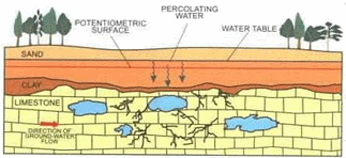 Sinkholes and the Aquifer
- Sinkholes form when groundwater erodes limestone, creating underground cavities.
- When water levels drop, these cavities can collapse, forming a sinkhole at the surface.
- Sinkholes serve as recharge points, allowing surface water to enter and replenish aquifers.
-
Learn more:
http://www.dep.state.fl.us/geology/geologictopics/sinkhole.htm
-
What should I do if a sinkhole develops on my property?
- Notify your local Water Management District and City of Tallahassee Aquifer Protection (850-891-1200).
- Fence or rope off the area.
- Keep children away.
- Protect the area from garbage and waste.
- Contact your homeowners insurance company.
Regulated Entity Inspection FAQs
- Who do I contact when sediment runs off a construction site?
- Some local governments have their own sediment and erosion control programs. Contact growth management department environmental division
Demolition Hazardous Waste Compliance Inspection FAQs
- What is a Hazardous waste?
- It is a waste that is dangerous or potentially harmful to our health or the environment. Hazardous waste can be liquid, solid, gas, or sludge. It can be discarded commercial products, like cleaning fluids or pesticides, or the by-products of manufacturing processes. Check the products label. An item is hazardous if the label contains any of the following terms: POISON, DANGER, WARNING, or CAUTION. Do NOT dispose with regular trash! http://www.dep.state.fl.us/waste/categories/hwRegulation/default.htm
- Where can I find environmental, regulatory and disposal information for fluorescent lights?
- Even though fluorescent lights require some amount of mercury to function, using high-efficiency fluorescents saves energy and actually results in a net reduction in mercury emissions from coal-fired power plants. The recycling and disposal of fluorescent lamps, particularly from non-household sources, further increases the net mercury benefits of fluorescent lights. To find out more about fluorescent lights, visit the following Web site at: http://www.dep.state.fl.us/waste/categories/mercury/default.htm
Additionally see: http://www.p2pays.org/Fluorescent/index.asp.
- How do I clean up a broken fluorescent lamp or compact fluorescent bulb?
- Is used oil a hazardous waste?
- What is universal waste?
- The universal waste agenda promotes the collection and recycling of certain widely generated hazardous wastes. Universal wastes are batteries, pesticides, mercury-containing equipment and
lamps. Florida has recently added pharmaceutical waste to the program.
- How do I dispose of used oil?
- It is illegal to dispose of used oil in a municipal solid waste landfill, on the ground, in storm drains, etc. Some local government solid waste programs may accept used oil on a regular basis or through a household hazardous waste collection day. Contact local solid waste officials for information about the disposal of used oil in your county. Local jobbers (companies that provide fuel) may also take used oil. They may charge a fee for this service. Check the "Yellow Pages" of your phone book for a listing of fuel companies.
- How do I dispose of used oil filters?
- Recycle them as scrap. Oil filters are highly-recyclable products containing materials desired by manufacturers for industrial use.
- Who regulates storage tanks?
- The Underground Storage Tank (UST) and Aboveground storage tanks (AST) are regulated in Florida by the Florida Department of Environment Protection (FDEP), with the exception of home heating oil tanks. FDEP regulates tanks 550 gallons and above and they must be registered with them. For more information about above ground storage tanks http://www.dep.state.fl.us/mainpage/programs/waste.htm
Aquifer Protection is responsible for those tanks below 549 gallons, all unregistered tanks.
If the tank is used to store chemicals, then you may need to contact SARA Right to Know staff
- Where do I get a septic tank permit?
- The environmental health staff in your county health department will check your property to determine if it is suitable for a septic tank. For a listing of county health departments and their environmental health staff, check the following Web site: http://www.leoncountyfl.gov/lcphu/
850-606-8150
- Where do I report a failed septic tank?
- Contact the environmental health staff in your county health department. See the above Web site for a listing.
- Where do I report Freon leaks?
- The U.S. Environmental Protection Agency is responsible for enforcing certain regulations under the Clean Air Act, including ozone-depleting substances, often referred to as Freon, refrigerants, CFCs or other names. For more information, check the following Web site: www.epa.gov/compliance/complaints or call a toll-free hotline for reporting, 800-296-1996 or 404-562-9197. NOTE: You can either fill out a complaint form or leave a message at the end of the recording for filing a complaint. http://www.dep.state.fl.us/mainpage/programs/air.htm
Illicit Discharge Investigation FAQs
- What is stormwater runoff?
- It is water from rain that "runs off" across the land rather than being absorbed into the ground. As this water flows toward the nearest low spot such as a stream, river, or other body of water, it picks up pollutants such as pesticides, fertilizers, oil, pet waste, leaves and more that can harm our water and environment. The following Web site has a wealth of information about stormwater runoff, issues, management and our role in reducing it: http://www.dep.state.fl.us/water/stormwater/npdes/index.htm
- What can I do about the stormwater that now flows into my yard from the new development?
- New development sometimes causes stormwater to flow rather than be absorbed into the ground. This occurs when trees and plants are removed and/or construction and paving create impervious surfaces. Leon County or City of Tallahassee has local stormwater ordinances; you may have some recourse for protecting your property. However, if you do not fall within either of these categories, your only other option may be to take private legal action. Contact your local government for more information.
- What is an illicit discharge?
- Illicit discharge means any discharge to the city's MS4 that is not composed entirely of stormwater, except discharges otherwise exempt under this division and discharges pursuant to valid federal, state or local permits.
- Who do I contact about an illicit discharge or illegal dumping?
Public Awareness FAQs
- How do I dispose of my household hazardous waste?
- Household hazardous waste; items such as cleansers, pesticides, furniture strippers, paints and paint thinners, etc., that you frequently keep under the sink or on a shelf in the garage can sometimes be recycled by donating them to other organizations that can use them. If you need to dispose of these items, however, they should be managed properly by taking them to a household hazardous waste collection event or facility. Contact your local solid waste management officials for information about the management of these wastes in your area. Find out where you can dispose of hazardous waste around Tallahassee.
- What can I recycle? Can I get a recycling bin here?
- What should I know about Fertilizers?
- Improper fertilizer application has been identified by the State as a major source of impairment caused by excessive nutrients to the City of Tallahassee's surface waters. Over fertilization is also reported as a cause for increasing levels of nitrogen in the ground water within the boundaries of the City. In order to address these concerns and protect our water resources, the City Commission adopted Ordinance No. 08-O-72AA on January 28, 2009. The ordinance regulates the proper use of fertilizers by any fertilizer applicator within the City, requires proper training and provides for certification of commercial and institutional fertilizer applicators.
- Where can I get information about the health effects associated with lead?
- Lead can cause health problems for people when swallowed or inhaled. While potentially harmful to individuals of all ages, lead exposure is especially harmful to children under six years of age because it affects their developing brains and nervous systems. Ingesting or swallowing lead-contaminated materials is the primary way people get lead poisoning at home. Small children are particularly susceptible because of their constant hand-to-mouth activity. For information, contact the Department of Health and Human Services, Health Hazards Control Unit.
- What do I do with my old, outdated computer and electronic equipment?
- Where can I get information about the health effects associated with asbestos?
- Where can I find information about training, permitting and accreditation requirements for those who remove or manage asbestos, or check to see if a removal contractor is licensed?
- Permits are required for most asbestos removal projects, and persons who manage asbestos must be trained and accredited. Notification is also required before demolition of a building. For more information, contact the www.dep.state.fl.us/air/emission/asbestos.htm